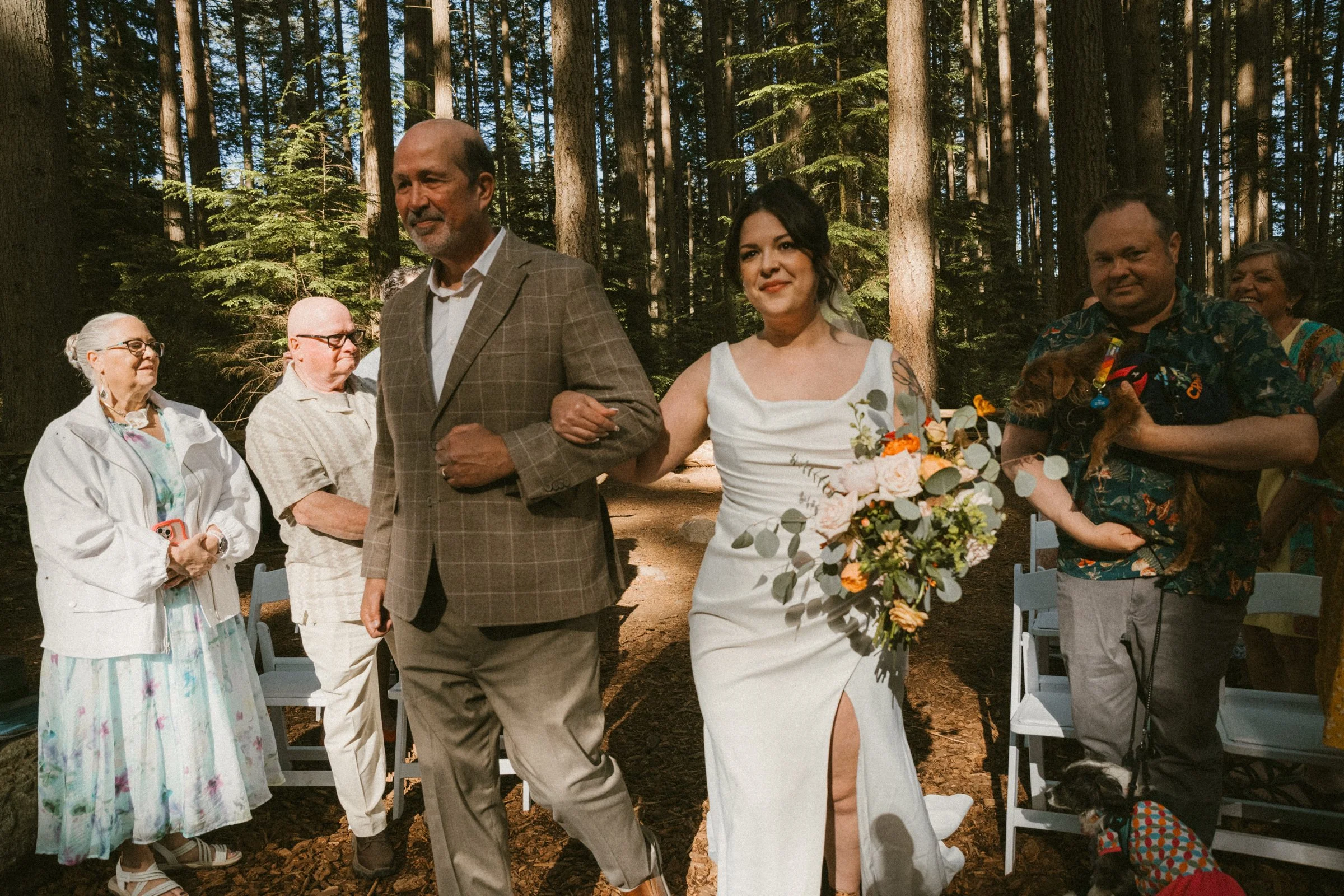
Photography by Chelsea Abram Photography.
CEREMONY SERIES: PART 6 OF 6 | SEA TO SKY ELOPEMENTS
Most elopements are just two people. But some are two people and a handful of others — parents, siblings, a best friend or two, the people who feel essential to the day even if you didn't want a wedding.
When you have a small guest count at an elopement or micro-wedding, the question of how to include people is worth thinking through deliberately. Guests at an intimate ceremony can feel like spectators — present but passive — or they can feel genuinely part of the day. The difference is almost entirely in the planning.
Here are the ways I've found most meaningful for involving small groups in an intimate ceremony.
Ask someone to give a reading
Inviting a guest to share a reading during the ceremony is one of the simplest and most effective ways to give them a role. It shifts them from audience to participant, it personalises the ceremony, and it gives that person something specific to contribute to your day.
Choose the reading yourself (or together), give it to them well in advance, and let them know where it falls in the ceremony. A prepared reader makes an enormous difference — and most people, given enough time and a text they connect with, do beautifully.
If you're uncertain what to give them, Blog 2 in this series covers a range of readings worth considering.
A group blessing
A group blessing is a moment in the ceremony where everyone present is asked to offer something — a wish, a intention, a silent promise of support — either aloud or in silence.
This can be structured ('I'll ask each of you to share one word or sentence that you wish for this couple') or open ('I invite everyone present to take a breath and offer whatever you want to offer in this moment'). Both work. The structured version is more reliable for groups who might feel put on the spot; the open version can be more organic and moving.
For outdoor ceremonies, a group blessing where everyone faces outward — toward the water, the mountains, the sky — and speaks to the landscape as much as to the couple has a particular power. You're acknowledging the place you're standing in while making a collective promise within it.
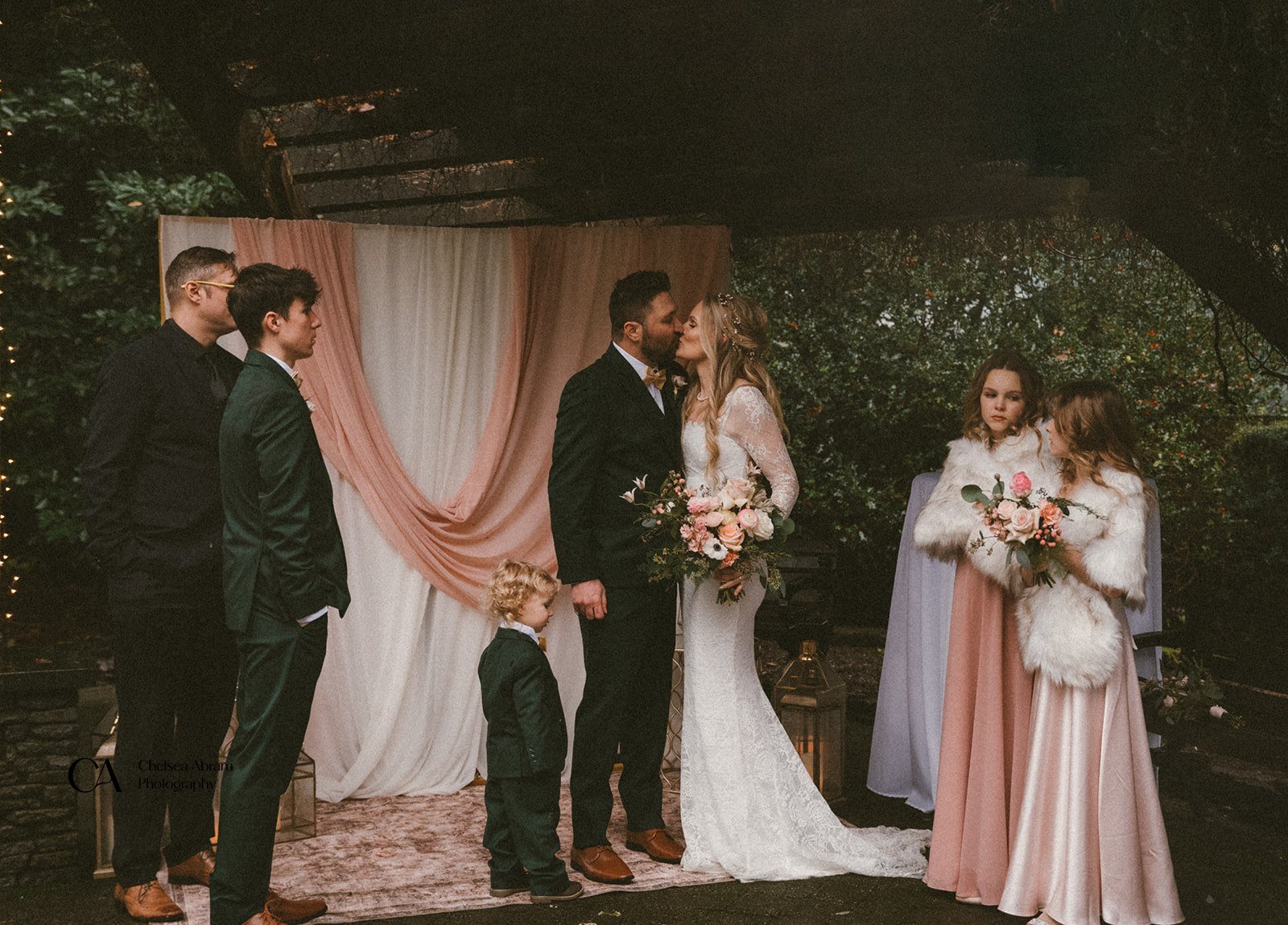
Photography by Chelsea Abram Photography.
Ask them to witness the vows in a specific way
The word 'witness' is usually used legally — someone who signs the marriage licence. But in a ceremony context, asking your guests to witness your vows in a conscious, intentional way adds meaning to their presence.
Your officiant can frame this explicitly: 'You are not just watching today. You are holding space for this commitment. You are the people this couple chose to have present for the most important thing they'll do together.'
That framing shifts the emotional register of being a guest. They're not there to observe. They're there to hold.
A shared ritual
Some of the rituals from Blog 3 can be extended to include guests. A whisky or wine ceremony can involve a toast to guests as well as between partners. A candle ceremony can have guests each hold a small taper, lit from a central flame. A handfasting can involve guests each tying a knot in the cord as a symbol of their support. A ring warming ceremony where the rings are passed around the group with a short prayer said silently by each person as a gesture of their support.
The most important consideration with any shared ritual: it should feel natural, not forced. If you need to explain why you're doing it mid-ceremony, it might not be the right fit. The best shared rituals are ones where the meaning is self-evident from the action.
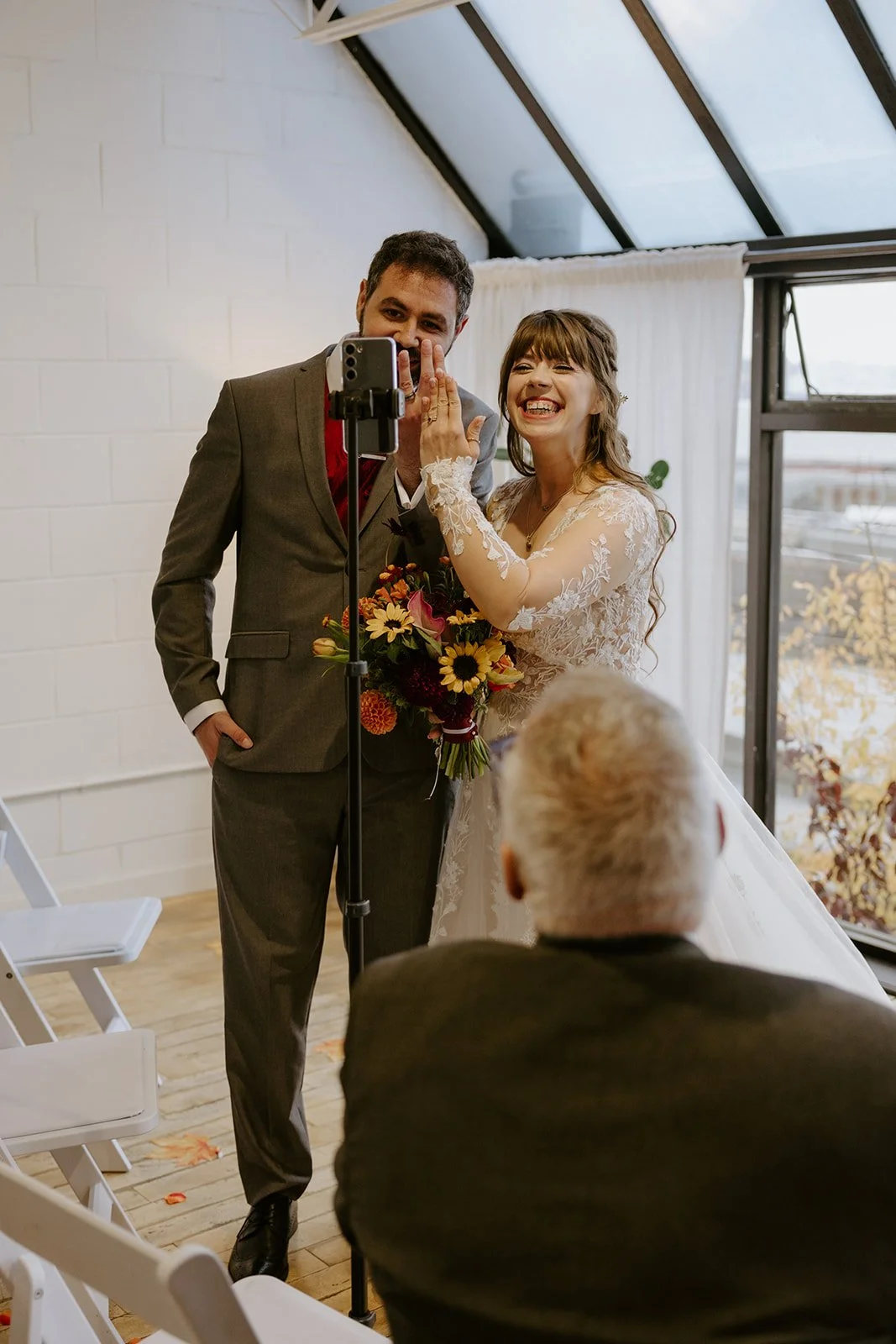
Photo by Janessa Alicia Studios.
A letter or note in advance
Before the ceremony, ask each guest to write a short letter or note to the couple — something to be read on the day, or saved and read together later. This gives everyone a meaningful way to prepare and contribute, and it produces something lasting: a small collection of words from the people who chose to be there.
This works particularly well for couples who have guests joining from a distance, or who want guests to feel involved even in the quiet preparation leading up to the day.
What to think about with small guest groups
The size of the group shapes what's appropriate. Two witnesses feel different from eight guests. Eight guests feel different from twenty.
For very small groups — two to four people — anything involving individual contributions works well because it's intimate and everyone knows each other. For slightly larger groups, structured participation (a reading, a group blessing) is more reliable than open participation.
The most important thing is that any guest involvement feel invited, not required. Nobody should feel put on the spot or unsure of what's expected. Brief, clear instructions — communicated before the ceremony, not for the first time during it — make all the difference.
Guests who feel held and included in an intimate ceremony often describe it as one of the most moving events they've ever attended. The intimacy of scale, combined with genuine participation, creates something that a large wedding simply can't replicate.
This is Part 6 of a 6-part series on personalising your elopement ceremony.
Part 1: How to Personalise Your Elopement Ceremony
Part 2: Ceremony Readings — and How to Choose One That Actually Fits
Part 3: Symbolic Rituals for Your Elopement Ceremony
Part 4: Writing Your Own Vows — A Practical Guide
Part 5: How to Honour Someone You've Lost in Your Ceremony
Sea to Sky Elopements plans planner-led, all-inclusive elopements across BC. Ceremony design — including how to involve the people who matter most — is part of every package we offer.