Photo by Janessa Alicia Studios.
CEREMONY SERIES: PART 5 OF 6 | SEA TO SKY ELOPEMENTS
This is the part of ceremony planning that doesn't come up in every conversation — and when it does come up, it often comes up quietly, almost like an afterthought. Someone will be partway through describing their ceremony vision and then say, almost carefully: my dad passed away last year, and I'd like to find a way to include him somehow.
It's one of the most meaningful things to get right. And it's worth more than an afterthought.
Here are the ways I've seen couples honour someone they've lost in an elopement ceremony — what works, what to think through, and how to hold it in a way that adds to the day rather than pulling you out of it.
A moment of intentional acknowledgement
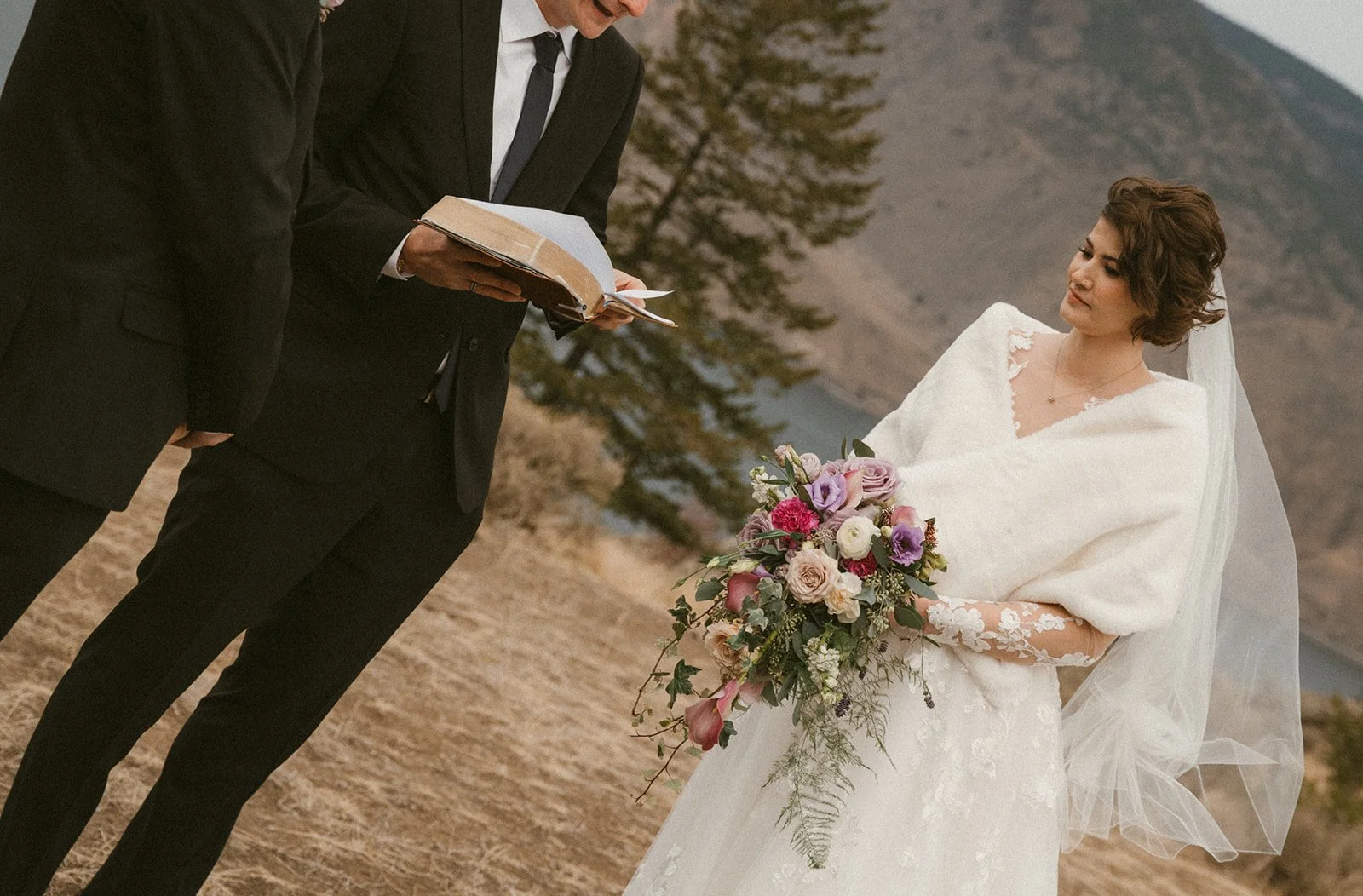
The simplest and often the most powerful approach is a direct, named acknowledgement during the ceremony. Your officiant speaks the person's name, says who they were, and acknowledges their presence in spirit. Short, clear, specific.
This doesn't have to be long to be meaningful. A single well-written sentence — 'We want to take a moment to honour [name], who loved [partner] deeply and would have been so proud today' — can move an entire ceremony. The specificity of the name is what does it. Not 'those who could not be here with us today' but this person, named, held.
Photography by Chelsea Abram Photography.
A reading or passage they loved
If the person you're honouring had a favourite poem, a passage from a book, a verse that mattered to them, reading it aloud during the ceremony is a way of letting them speak. Their voice, through something they loved, in the middle of your wedding day.
This is particularly moving when the reading is something unexpected like the poem they had on their fridge, or the passage they quoted in a letter once. The specificity makes it unique.
One reading that works well across many different contexts — secular, spiritual, and somewhere between — comes from the idea that love, once given, does not disappear. Whatever the source, the sentiment is the same: the people who shaped us are still shaping us, even after they're gone.
Something physical that carries them
Carrying something that belonged to them, or that represents them, into the ceremony is a quiet and private way to hold them close.
A piece of their jewellery worn or carried. A photo tucked into a bouquet. A small object in a pocket — something they gave you, something of theirs you kept. These don't need to be announced or explained during the ceremony to be meaningful. They're for you.
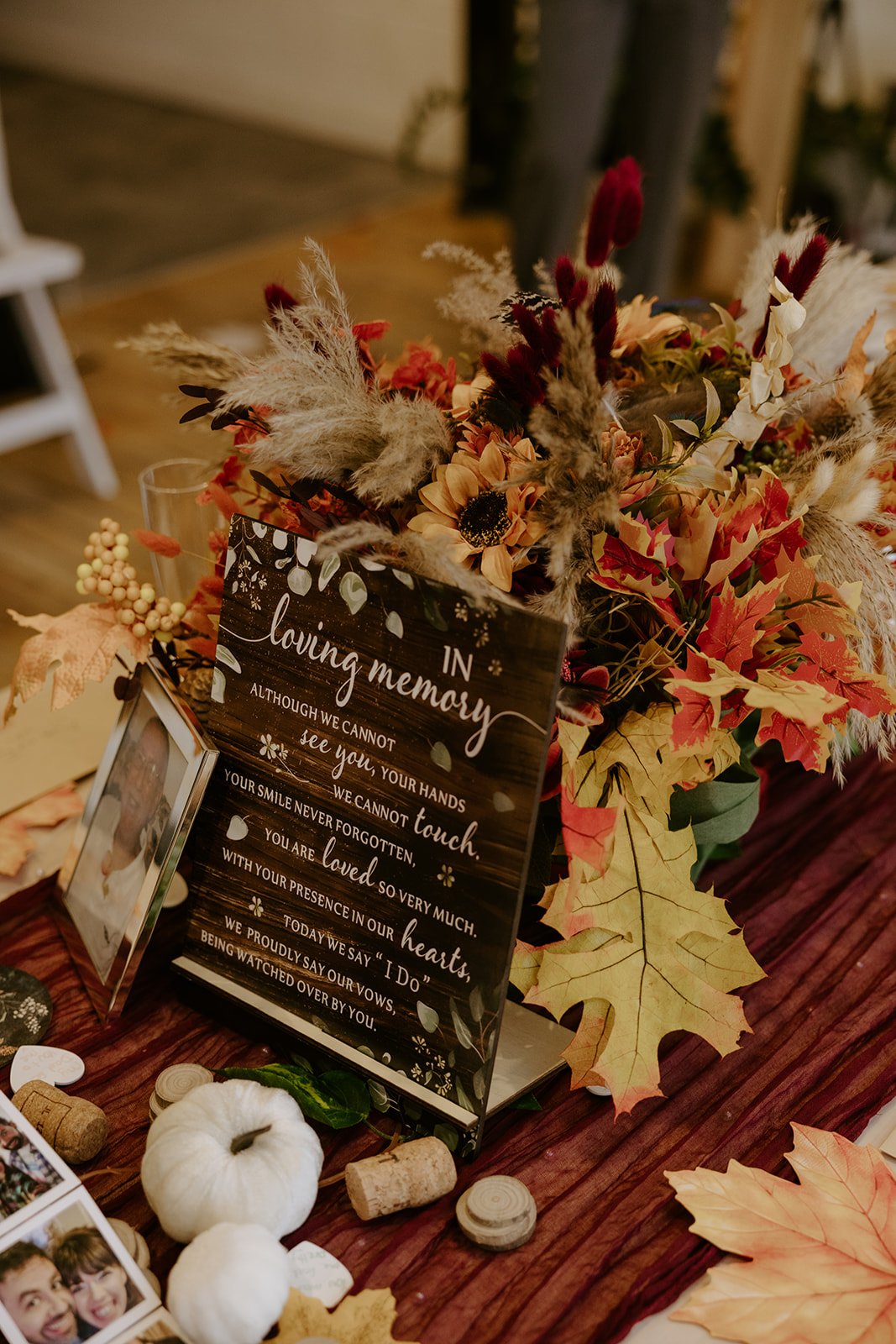
Some couples choose to display a framed photo at the ceremony site — a small, beautiful acknowledgement that this person is part of the day even though they couldn't be there in person. For intimate elopements, this can be done simply and without it feeling performative.

Photo by Mad Magic Photography.
A toast or moment of silence
If you're sharing a drink during the ceremony — a whisky ceremony, a wine toast, something celebratory — pouring a small measure for the person you're honouring is a gesture that's been part of commemorative traditions across many cultures. Simple, physical, and often very moving.
A moment of silence — brief, intentional, held by your officiant — can also be deeply powerful. Silence in a ceremony feels different from silence anywhere else. It gives everyone present space to hold that person in their own way.
In your vows
Your vows are the most personal part of the ceremony, and they're the right place to speak directly about someone who is gone if you want to. It might be a single line: 'I carry my mum with me today and I know she'd love you.' It might be a fuller acknowledgement of how their life or their love shaped who you became.
This is entirely at your discretion. Some people want to say it out loud in the ceremony. Others prefer to hold it privately. Both are valid — and both honour the person just as fully.
What to think about when planning this
The most important thing: decide in advance how much emotional space you want to give this in the ceremony, and plan accordingly. A brief, named acknowledgement adds warmth and meaning. A longer tribute can be equally appropriate. What you want to avoid is it catching you off guard — being surprised by your own grief mid-ceremony in a way that takes you out of the moment entirely.
Brief and planned is almost always better than lengthy and unprepared. Your officiant should know about this early in the planning process so they can build it in with care and give you the chance to review how it's worded.
And if you find yourself tearing up during this part of the ceremony — that's okay. It's more than okay. The people who love you, in the room or in spirit, understand completely.
This is Part 5 of a 6-part series on personalising your elopement ceremony.
Sea to Sky Elopements approaches ceremony planning with care for every element, including the ones that carry grief alongside joy. If this is something you're thinking about, we can talk through it together.